Hebrew Letter Chart
The Hebrew alphabet — the aleph-bet — has 22 letters, all consonants, written from right to left. Five letters take a different shape at the end of a word. This chart shows every letter with its name, sound and traditional numerical value, lets you practise with flashcards, and adds up the value of any Hebrew word or name.
- Free to use
- No sign-up
- Runs in your browser
Hebrew letters: chart, quiz and values
Hebrew Alphabet Printables
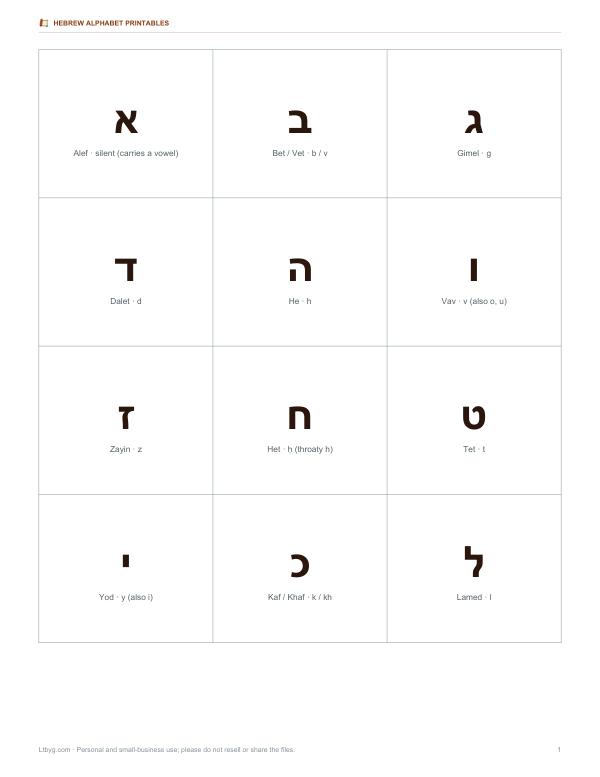
Printable Hebrew alphabet set: a large letter chart, flashcards with names and sounds, a final forms sheet and a letter naming worksheet.
- Letter chart (PDF)
- Flashcards (PDF)
- Final forms (PDF)
- Letter worksheet (PDF, DOCX)
Formats: PDF, DOCX. Instant download after payment (link valid 72 hours, up to 5 downloads). AI-assisted: the templates were drafted with AI help and reviewed and laid out before publishing.
$5.00 USD, one-time 4 files · about $1.25 each
- Instant download
- 7-day refund
- Secure checkout by Stripe
7-day money-back guarantee. Full refund within 7 days of purchase, even after you download.
Free sample: Hebrew Final Forms (PDF, 100 KB)
Full refund within 7 days — see the refund policy and license.
Free printables
Single sheets you can print right now, no sign-up. The full pack adds every sheet in one download plus the editable files.
 Printable Hebrew Letter Worksheet
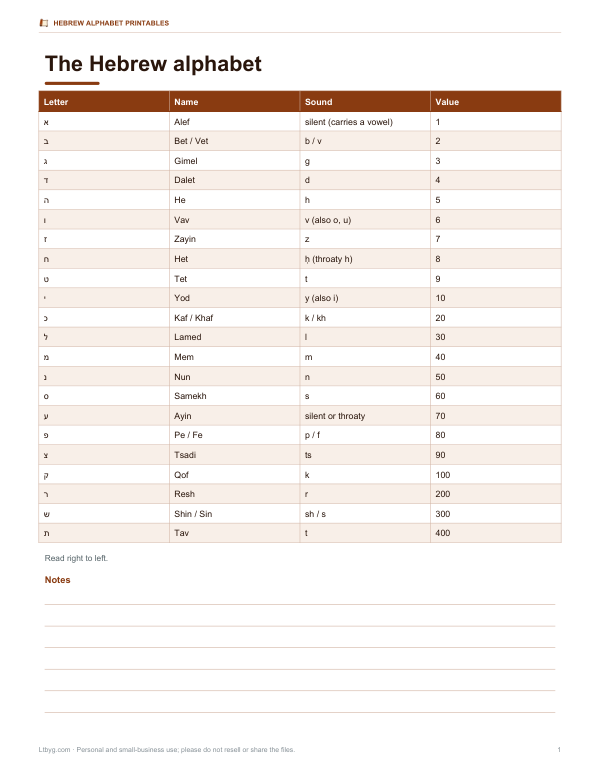
The Hebrew alphabet
| Letter | Name | Sound | Value |
|---|---|---|---|
| א | Alef | silent (carries a vowel) | 1 |
| ב | Bet / Vet | b / v | 2 |
| ג | Gimel | g | 3 |
| ד | Dalet | d | 4 |
| ה | He | h | 5 |
| ו | Vav | v (also o, u) | 6 |
| ז | Zayin | z | 7 |
| ח | Het | ḥ (throaty h) | 8 |
| ט | Tet | t | 9 |
| י | Yod | y (also i) | 10 |
| כ | Kaf / Khaf | k / kh | 20 |
| ל | Lamed | l | 30 |
| מ | Mem | m | 40 |
| נ | Nun | n | 50 |
| ס | Samekh | s | 60 |
| ע | Ayin | silent or throaty | 70 |
| פ | Pe / Fe | p / f | 80 |
| צ | Tsadi | ts | 90 |
| ק | Qof | k | 100 |
| ר | Resh | r | 200 |
| ש | Shin / Sin | sh / s | 300 |
| ת | Tav | t | 400 |
Hebrew is read from right to left. The alphabet has no separate capital letters, and the letters are all consonants; vowels are shown in some texts by small dots and dashes (niqqud) above and below the letters, and are usually left out in everyday modern writing.
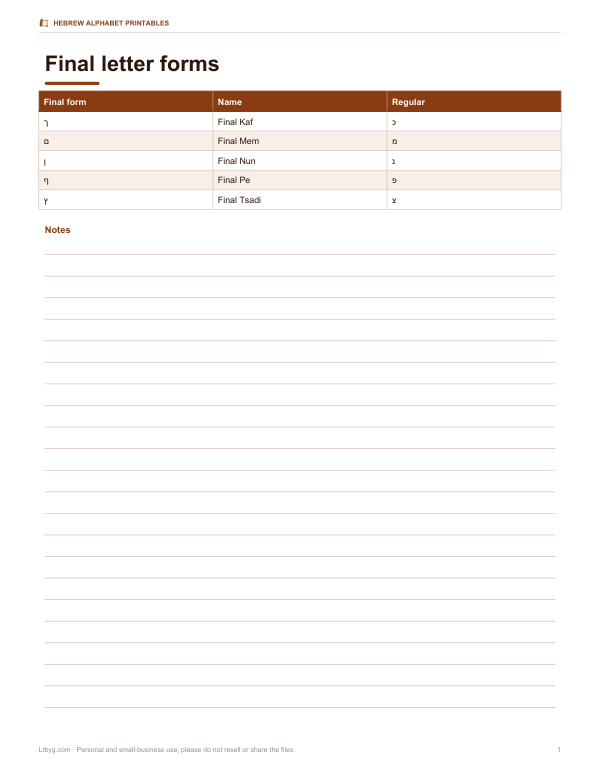
Final forms
| Final form | Name | Regular form |
|---|---|---|
| ך | Final Kaf | כ |
| ם | Final Mem | מ |
| ן | Final Nun | נ |
| ף | Final Pe | פ |
| ץ | Final Tsadi | צ |
Five letters change shape when they come at the end of a word: kaf, mem, nun, pe and tsadi. The sound doesn’t change. Most final forms extend below the line.
Letters with two sounds
Three letters have two common pronunciations in modern Hebrew, shown in pointed texts by a dot (dagesh) inside the letter: bet (b) and vet (v), kaf (k) and khaf (kh), and pe (p) and fe (f). The letter shin is pronounced sh when the dot is on the right and s (sin) when it is on the left. Some letters sound alike in modern Israeli Hebrew — tet and tav are both t, and kaf and qof are both k — though they were distinct in older pronunciation.
Hebrew numerals and gematria
Hebrew letters also serve as numbers: alef to tet are 1–9, yod to tsadi are 10–90, and qof to tav are 100–400. Hebrew dates and chapter numbers are still written this way. Gematria is the traditional practice of adding up the values of a word’s letters; for example חי (chai, “life”) is 8 + 10 = 18, which is why gifts in multiples of 18 are popular. The calculator uses the standard values, with final forms counted like their regular letters.
How to use the chart
- Browse the chart to learn each letter’s name, sound and value.
- Switch to the flashcard quiz to test yourself; wrong answers show the correct letter and sound.
- Choose word value to type or paste Hebrew text and see the letter-by-letter total.
- Print the charts from the pack for your desk or classroom.
Worked example
Typing שלום (shalom, “peace”) into the word value tool gives shin 300 + lamed 30 + vav 6 + final mem 40 = 376. The chart shows that the last letter is the final form of mem, which looks like a closed square. In the quiz, a common mix-up is between bet (ב) and kaf (כ) — bet has a small tail at the bottom right, while kaf is rounded.
Hebrew in everyday life
Modern Hebrew is the everyday language of Israel and is also used in Jewish prayer and study around the world. Street signs, newspapers and text messages are usually written without vowel marks, so readers rely on context and familiar words — which is why learning the letter shapes well matters. Printed books for children and learners, prayer books and poetry often include the vowel points.
Sounds that English doesn’t have
Two sounds need practice for English speakers: ḥet (ח), a breathy h from the back of the throat, and khaf (כ without a dot), like the “ch” in Scottish loch. In modern Israeli pronunciation many speakers pronounce ḥet and khaf the same way. The letters alef and ayin are usually silent in modern speech and simply carry the vowel sound.
Print and handwriting
The letters in the chart are the printed “square” script. Everyday handwriting uses a cursive script whose letters look quite different — for example, cursive alef resembles a small rounded “k”, and cursive lamed is a simple loop. Learners usually read print first and learn cursive for writing. Rashi script, another style, appears in traditional commentaries.
Tips for learning the letters
- Learn the letters in groups of similar shapes: ב כ, ד ר, ה ח ת, ו ז, ט מ ס ם.
- Say the letter name and sound aloud each time you see it.
- Write each letter a few times — the direction of strokes helps memory.
- Read short words you already know, such as names and greetings.
- Practise with the final forms once the regular letters feel familiar.
Privacy
Everything runs in your browser; nothing you type is sent anywhere.
Frequently asked questions
How many letters are in the Hebrew alphabet?
22 letters, plus 5 final forms.
Which way is Hebrew written?
From right to left.
What are the Hebrew final letters?
Final kaf, mem, nun, pe and tsadi.
What is gematria?
Adding the numerical values of the letters in a word.
Why is 18 significant?
The letters of chai, “life”, add up to 18.
Does Hebrew have vowels?
Vowels are shown by optional marks (niqqud) around the letters.
Is Hebrew cursive different?
Yes — handwriting uses a cursive script with different shapes from print.
How long does it take to learn the Hebrew letters?
Many learners recognise all the letters within two to four weeks of short daily practice.
Which Hebrew letters look alike?
Bet and kaf, dalet and resh, he and ḥet, and vav and zayin are often confused.